Why this matters now
For two decades, IAM focused on authentication, authorization, and policy enforcement. We built directories, implemented single sign-on, introduced multi-factor authentication, and layered privileged access controls. These were necessary foundations. But they were built for a world of human users logging into applications.
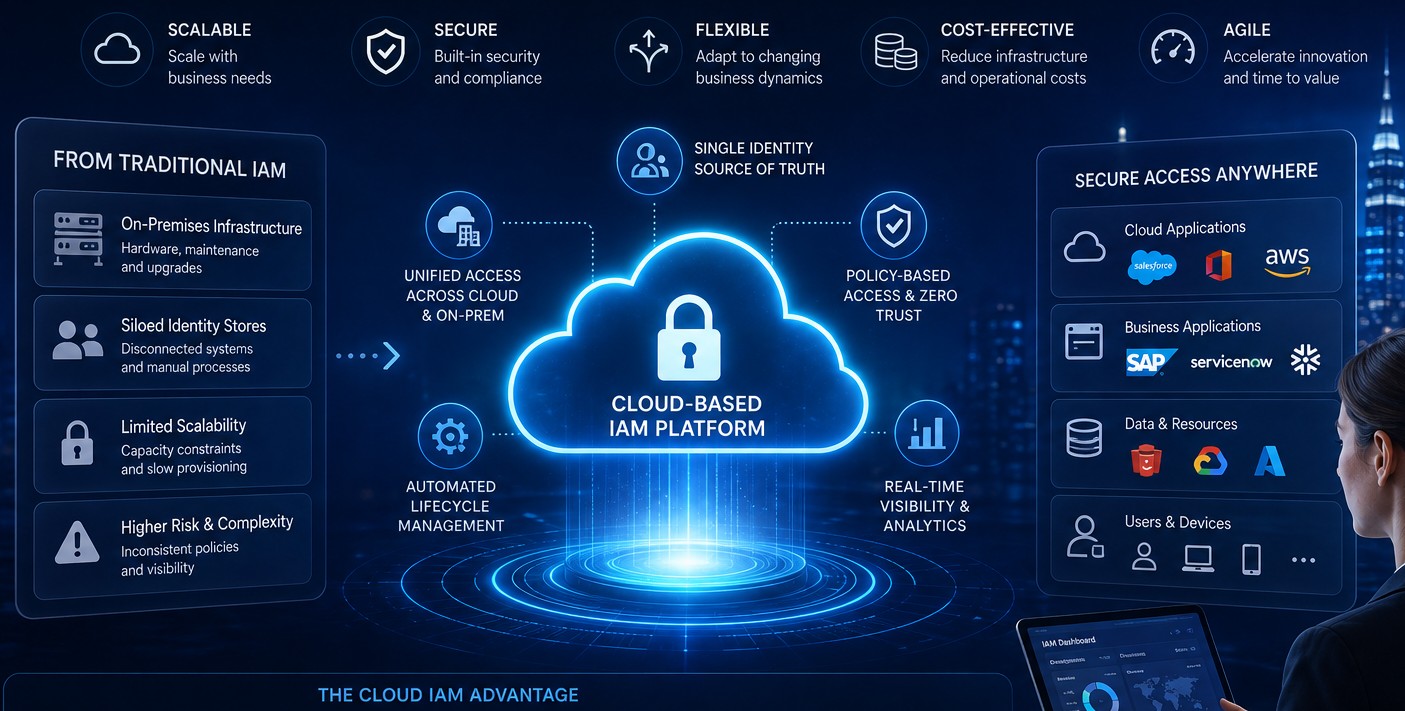
That world no longer exists. Today, identities are human, machine, API, workload, bot, and increasingly, AI agents. Access decisions are dynamic. Context changes in milliseconds. Infrastructure is distributed across clouds, edge environments, and decentralized ecosystems. The perimeter is no longer sufficient — and the user may not even be a person.
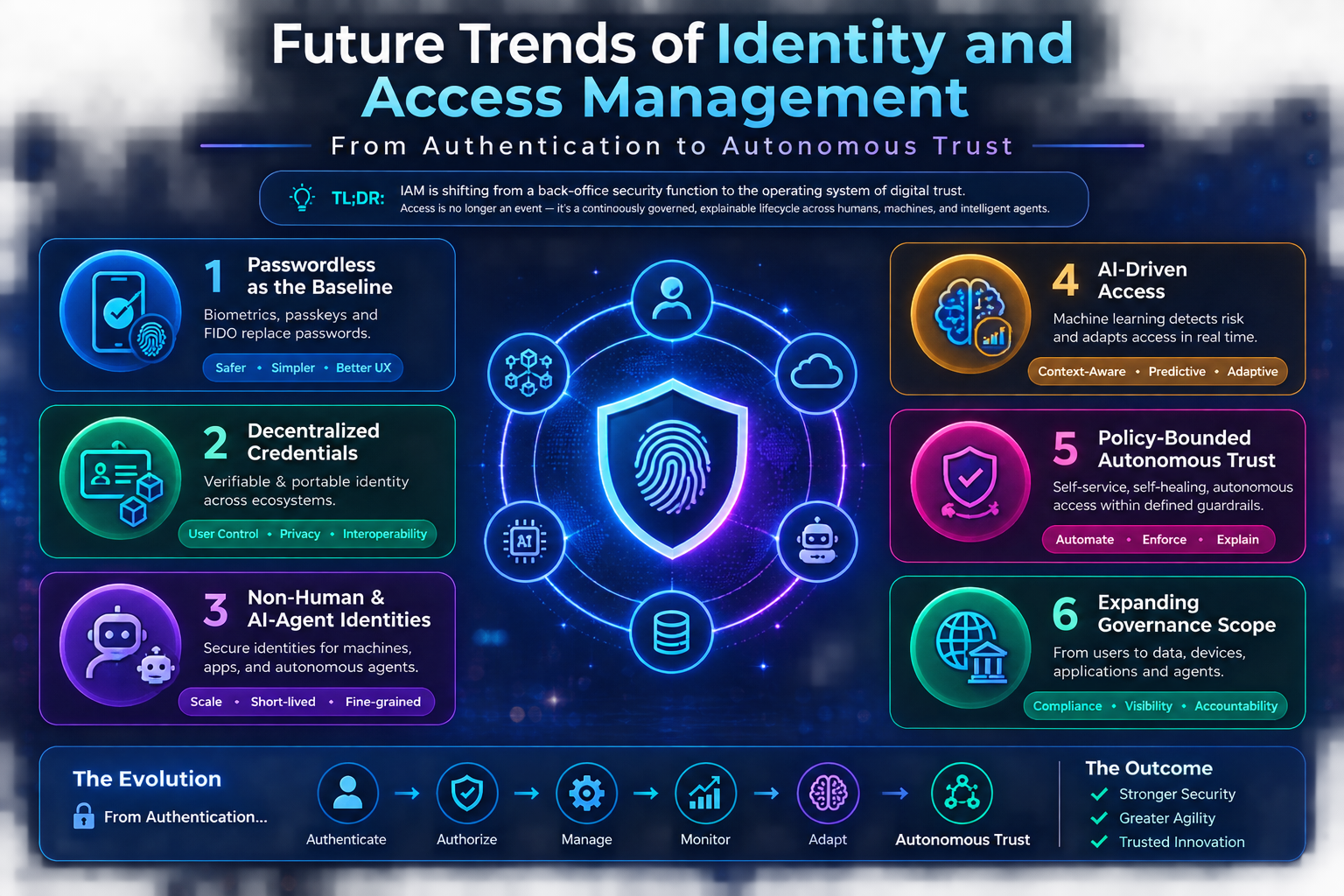
So what does IAM become in this new environment? Six trends define the answer.
Six trends reshaping IAM
1. Passwordless as the baseline, not the innovation
Passwordless authentication is rapidly becoming table stakes. FIDO2, passkeys, biometrics, and device-bound credentials reduce reliance on shared secrets and phishing-prone credentials — and major platforms are scaling passkeys to billion-user reach, including Microsoft's plan to implement passkeys for over one billion users (FIDO Alliance).
But passwordless isn't the destination. If authentication becomes seamless, the strategic differentiator shifts to continuous assurance: verifying identity not just at login but throughout a session, incorporating behavioral signals and contextual intelligence, and adapting access decisions dynamically based on risk posture.
Key takeaway: Authentication is no longer an event. It is a lifecycle.
2. Decentralized identity and verifiable credentials
Decentralized identity introduces a powerful shift: individuals and entities control their own verifiable credentials. Trust moves from centralized directories to cryptographic proofs. The W3C's Verifiable Credentials Data Model v2.0 — a formal W3C Recommendation — defines cryptographically secure, privacy-respecting, machine-verifiable credentials exchanged between issuers, holders, and verifiers (W3C).
This is promising but still dependent on interoperability, governance, revocation, and trust frameworks. The strategic questions remain: who governs trust frameworks, how enterprises validate decentralized credentials at scale, and how revocation and risk scoring work in distributed ecosystems. Decentralization challenges the traditional enterprise IAM model — where identity is centrally issued and controlled.
Key takeaway: Decentralized identity shifts trust from a directory you own to proofs you must verify. Governance, not cryptography, is the hard part.
3. The rise of non-human and AI-agent identities
The most significant transformation may not be passwordless or decentralized identity — it is the rise of autonomous actors. AI agents can request access, execute workflows, call APIs across systems, trigger financial transactions, and make decisions on behalf of humans.
If an AI agent can act, it must be governed. If it can access, it must be identified. If it can decide, it must be accountable. This is no longer hypothetical — industry coverage citing Gartner predicts that by 2028, a quarter of enterprise breaches may be traced back to AI or agent-based attack surfaces (Global Security Mag, citing Gartner; MojoAuth, citing Gartner).
This raises foundational questions: Who sponsors an AI identity? What is its lifecycle? How are permissions scoped and monitored? Can an agent delegate authority? How is accountability assigned when actions are autonomous? IAM is evolving from human identity management toward identity and agent access management.
Key takeaway: Treat every AI agent like a privileged user you haven't onboarded yet. If it can't be sponsored, scoped, and revoked, it can't be trusted.
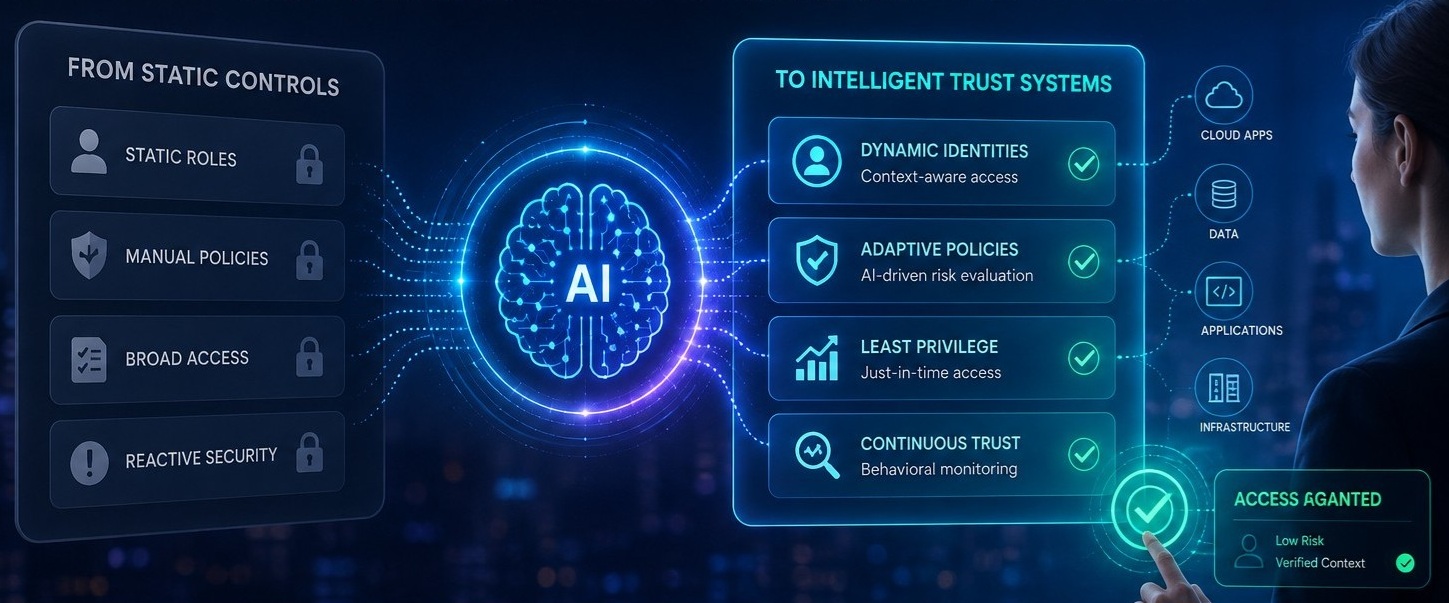
4. Contextual, risk-adaptive, and AI-driven access
Access control is shifting from static role-based models to contextual, risk-aware, and behavior-informed decisions. AI is now being embedded into IAM platforms to detect anomalous access patterns, predict privilege misuse, automate entitlement reviews, recommend least-privilege policies, and identify orphaned or risky identities. The payoff is measurable: industry coverage citing Gartner forecasts that effective AI deployment could reduce human-touch security incidents by 30% by 2028 (MojoAuth, citing Gartner).
But as AI begins to govern access, another layer of governance is required. Who governs the AI that governs access? How are models trained? What biases exist in risk scoring? How do we audit AI-driven access decisions? Can denials or escalations be explained? Explainability is becoming a core IAM requirement. Established assurance frameworks such as NIST SP 800-63-4 can help structure identity proofing, authentication, and federation controls, but AI-driven access decisions also need their own audit, override, and model-governance processes (NIST).
Key takeaway: When AI governs access, the question isn't whether it's automated — it's whether every decision is explainable, auditable, and human-overridable.
5. From Zero Trust to autonomous trust
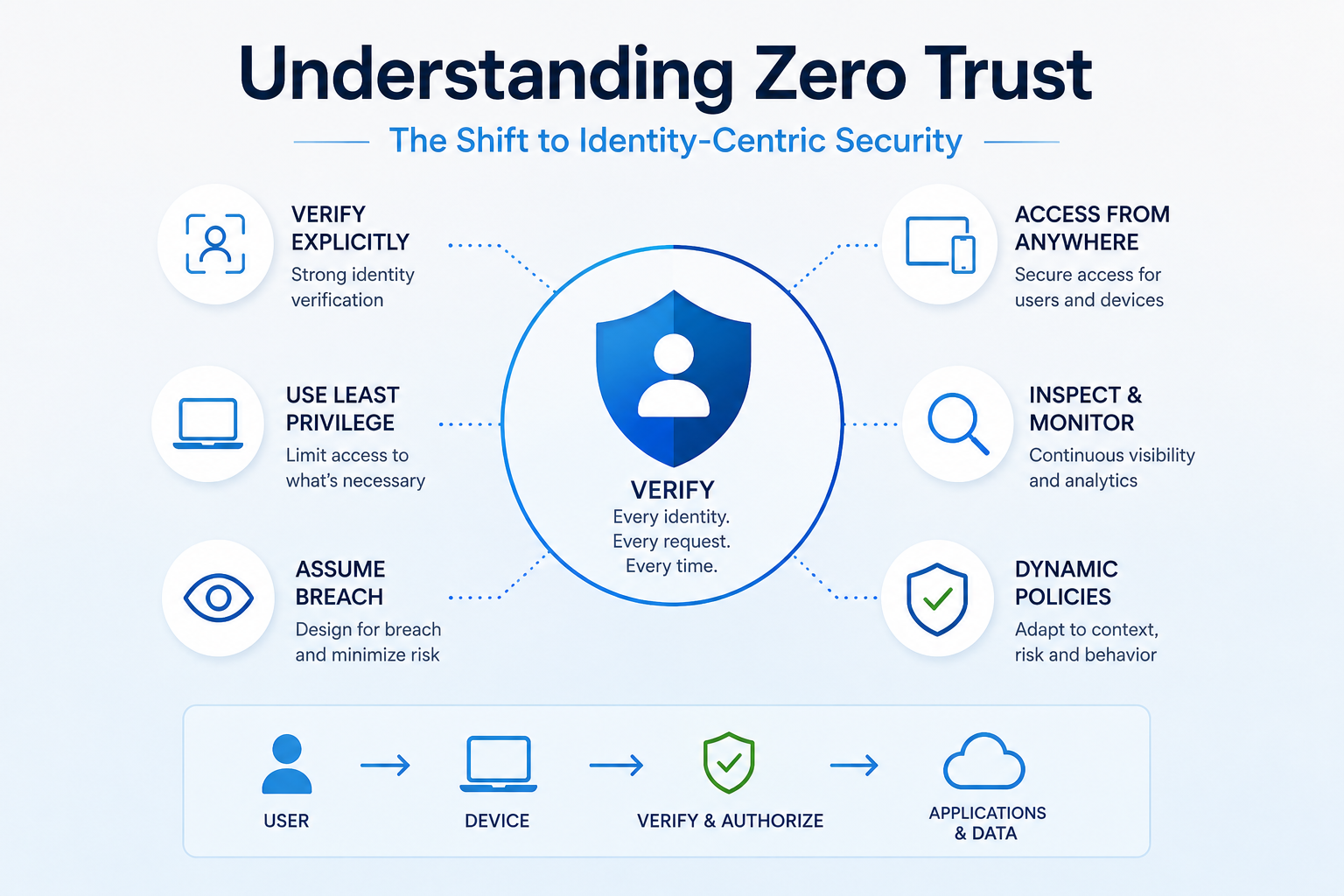
Zero Trust reframed security: never trust, always verify. The next evolution — what's usefully described as "autonomous trust" — envisions continuous validation, self-adjusting permissions, real-time identity-graph intelligence, and policy enforcement that adapts in context.
But this should not be read as "access without humans." A responsible autonomous-trust model is policy-bounded, auditable, explainable, and human-overridable. Access is not granted permanently but continuously earned. Privileges are not assigned statically but dynamically calibrated. Identities are not static objects but evolving risk entities.
Key takeaway: Autonomous trust isn't trust without governance — it's trust that adapts within guardrails. Automation without override is a liability.
6. The expanding scope of IAM
IAM is now intersecting with cloud infrastructure governance, data access control, DevSecOps pipelines, AI model permissions, regulatory compliance, and digital-identity ecosystems. IAM leaders must think beyond provisioning workflows and understand identity risk as business risk, access as a governance function, and identity architecture as strategic infrastructure.
Key takeaway: IAM is no longer a security function. It's a board-level digital-trust imperative — if leadership treats it that way.
IAM today vs. IAM next
| Dimension | IAM today | IAM next |
|---|---|---|
| Authentication | Passwordless at login (FIDO Alliance) | Continuous assurance throughout the session |
| Credential model | Centrally issued | Portable, verifiable (W3C VC v2.0) |
| Identity scope | Primarily human | Human + machine + AI agents (Gartner, cited) |
| Access model | Static RBAC | Contextual, risk-adaptive |
| Trust model | Zero Trust (always verify) | Policy-bounded autonomous trust |
| AI governance | AI assists humans | Explainable, auditable, human-overridable |
| Identity assurance | Basic authentication requirements | Assurance levels for proofing, authentication, and federation (NIST SP 800-63-4) |
| Operating model | Provisioning workflows | Trust orchestration |
Future-ready IAM checklist
- Passwordless + continuous assurance — Have we moved beyond passwords to passkeys, and do we verify identity throughout sessions, not just at login?
- Verifiable credentials — Can we issue, verify, and revoke portable credentials using open standards?
- Agent governance — Do we have sponsorship, scoping, lifecycle, and revocation for every AI agent and service account?
- Risk-adaptive access — Are access decisions informed by behavioral signals, device posture, and context?
- Explainable AI — Can we explain, audit, and override every AI-driven access decision?
- Autonomous-trust guardrails — Is automation policy-bounded, auditable, and human-overridable?
- Expanded scope — Does IAM governance extend to cloud infrastructure, data, DevSecOps, and AI model permissions?
- Board-level posture — Is identity risk reported to leadership as business risk?
If the answer to any of these is "no," the organization is optimizing today's IAM rather than building tomorrow's trust.
The strategic inflection point
The future of IAM will not be defined by tools. It will be defined by principles: continuous verification, decentralized trust, agent governance, explainable AI-driven decisions, lifecycle-based identity management, and dynamic least privilege.
Organizations must ask: What identities exist in our ecosystem that we do not fully see? How do we govern identities that can act autonomously? How do we measure trust? How do we balance privacy, security, and usability? What does identity accountability mean in an AI-driven enterprise?
IAM is no longer about managing access. It is about orchestrating trust in a world of humans, machines, and intelligent agents. The question is not whether IAM will evolve. The question is whether organizations will evolve with it.